Forensic Governance
The ability to reconstruct what actually happened. Not explain. Reconstruct.
An organisation faces scrutiny. A regulator asks for the record. An auditor reconstructs the timeline. An investigator examines the decision. At that moment, the organisation either has forensic governance in place or it is building it under pressure. The first case survives. The second case does not.
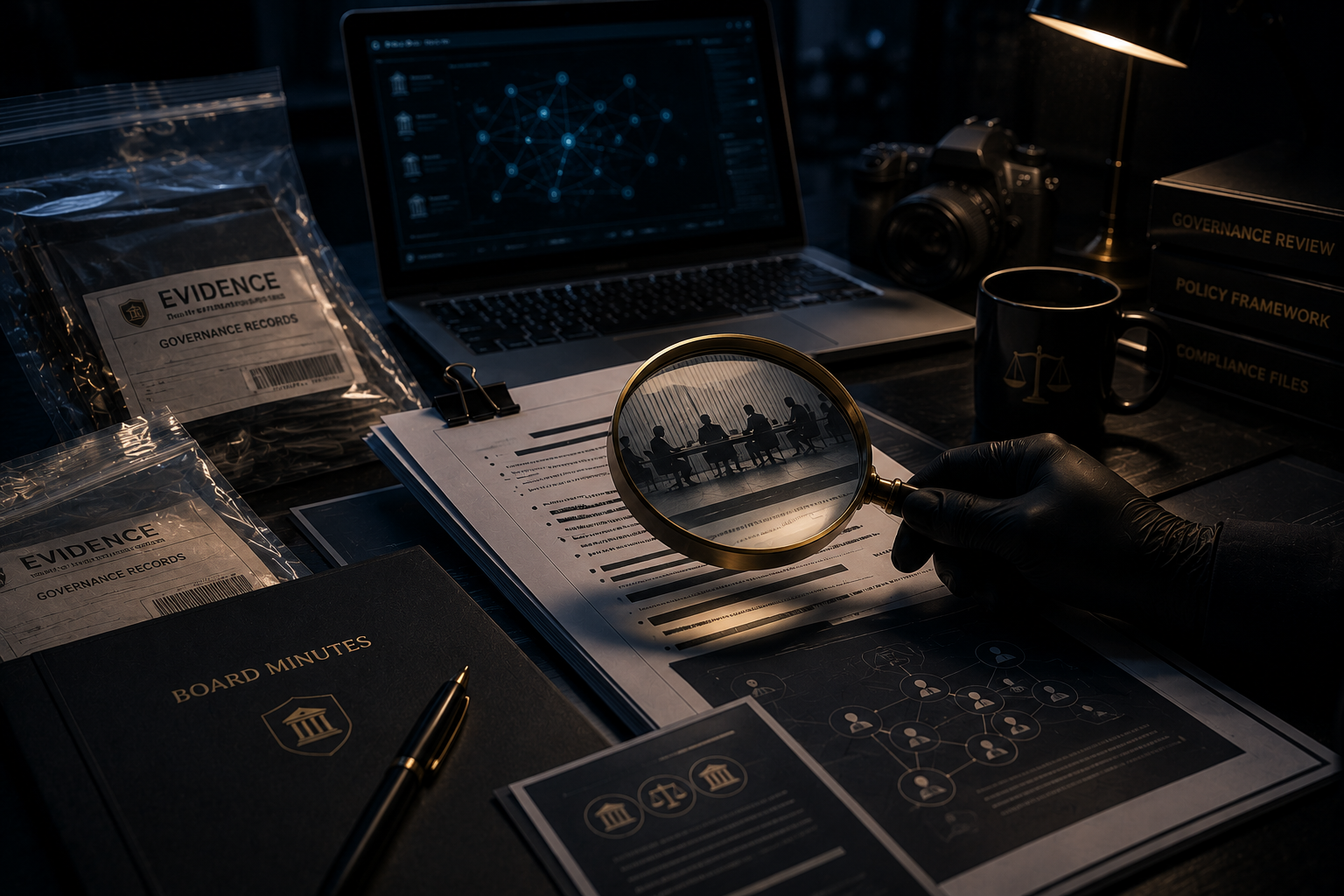
Reconstruction, not interpretation
Forensic governance is the ability to answer a regulator, auditor, or investigator with preserved evidence, not reconstructed narrative. It means showing what decisions were made, by whom, on what basis, and what happened as a result. Not interpretation of what should have happened. Not explanation of what was intended. Reconstruction of what was actually decided and why.
If evidence of governance is demanded tomorrow, can you produce it from preserved records, or must you rebuild it from memory and scattered sources?
Most organisations confuse two things. Governance is the process of making decisions. Forensic governance is the ability to prove those decisions were made. The first is easier. The second is what matters when pressure arrives.
Scrutiny always asks the same question
A regulator does not ask if governance exists. They ask what evidence shows governance was real. An auditor does not accept explanation. They reconstruct the timeline from records. An investigator does not assume good intent. They show what was known and what was decided anyway.
Forensic governance exists because scrutiny operates on a simple principle. Show, do not tell. Evidence, not assertion. The organisation that can show its governance survives scrutiny. The organisation that can only explain it does not.
This applies across every domain. Board decisions. Audit readiness. Regulatory defensibility. Incident investigation. The same question returns: can you reconstruct what happened from what you preserved, or must you rebuild it under pressure.
Four foundations of forensic reconstruction
Evidence integrity
Records that cannot be altered after the fact, so what is shown reflects what actually occurred.
Decision provenance
A complete chain connecting decision, approver, evidence, and reasoning, preserved at the time the decision was made.
Operational replayability
The ability to show how the organisation operated at a specific point in time, recreating the context in which decisions were made.
Interpretive continuity
A shared understanding across functions of what evidence means and how decisions map to their supporting documentation.
How organisations lose the ability to reconstruct
From scattered evidence to reconstructable governance
Standard - Structured Dossier Foundation
Organises governance facts, evidence, decisions and obligations into a defensible structure where the chain from decision to outcome is clear and retrievable.
Pro - Governance & Integrity Layer
Adds controls around evidence integrity, decision responsibility, and access audit boundaries so records cannot be altered and the chain is verifiable.
Dossier Secure Enterprise is being engineered as a complete forensic governance system. It connects events, actors, policies, decisions, evidence and audit trails into a reconstructable chain designed specifically so organisations can show, not explain, what happened.
Forensic governance explained
What is forensic governance?
The ability to reconstruct from preserved evidence exactly what decisions were made, by whom, on what basis, and what happened as a result. Not interpretation, not summary. Reconstruction.
How is forensic governance different from compliance?
Compliance asks: did we follow the rules? Forensic governance asks: can we prove what actually happened? The second question is harder and more important under pressure.
When do organisations need forensic governance?
When they face scrutiny. An audit. A regulator. A lawsuit. An incident investigation. At that moment, forensic governance is either already in place or it has to be built retroactively under pressure.
What makes evidence forensically sound?
It is contemporaneous, unaltered, connected to its decision context, and preserves not just what was decided but how the judgment moved through the organisation to that decision.
Is Dossier Secure a forensic governance tool?
Dossier Secure structures evidence so forensic governance becomes possible. Standard and Pro layers provide the foundation. Enterprise is being engineered as a full forensic reconstruction system.
Test whether your organisation can reconstruct its governance today
The 48-hour governance test shows exactly where your evidence is incomplete or unreconstructable. Before scrutiny forces the same question.