A critical ICT supplier fails. Now prove how your decision was made.
This is where most organisations discover the real weakness: the decision made, but the demonstrable trail cannot be produced under pressure.
Monday morning, 08:14. Operations are hit. Continuity, contractual obligations and reputation come under immediate pressure. What matters next is not intention. What matters is whether you can show exactly what was decided, by whom, on what basis, with which risks, and supported by which evidence.
This page is not theory. It shows what a defensible reconstruction line looks like when pressure is real.
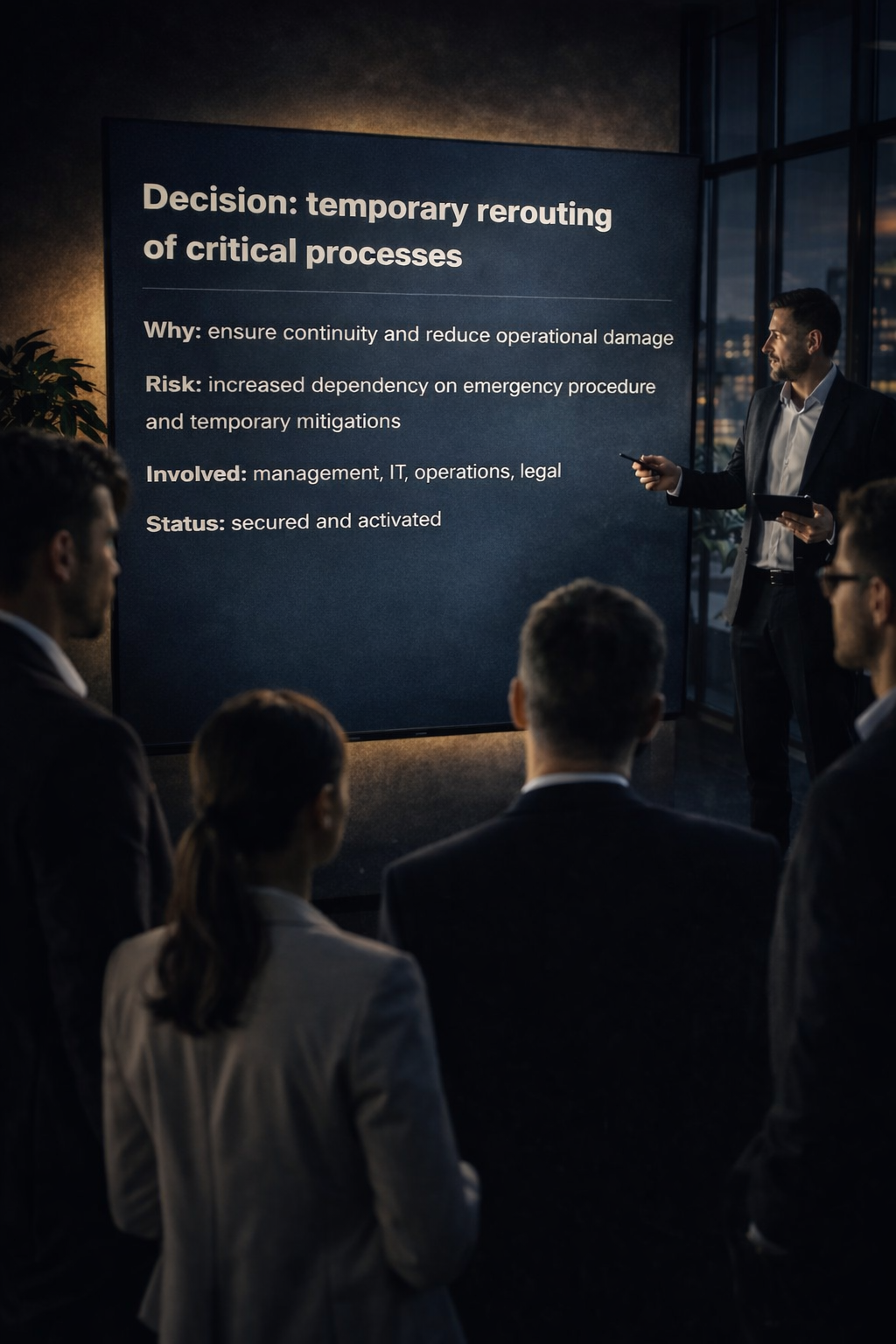
Show exactly how this decision was made.
In a serious escalation, it is not enough that a decision was made. It must be demonstrable how it came into existence — complete, chronological and traceable.
“Show exactly how this decision was made.”

Not only what happened. But why, by whom and based on what.
Under pressure, most organisations do not lack information. They lack one defensible line that makes the decision explainable, transferable and provable.
What this example makes visible
- What exactly was decided
- Why that route was chosen
- Who carried responsibility
- Which risks were identified and accepted
- Which information was used
- Which actions followed immediately
Without this structure, reconstruction becomes discussion. And discussion is weak the moment external scrutiny begins.

The reality under pressure
Decisions are made fast. Without structure, context disappears, ownership blurs and evidence fragments across systems, people and versions.
This is where governance stops being operational and becomes evidential.
Once the outage becomes known, the issue is no longer only continuity. It becomes a governance question: which risks were identified, which choices were made and how will those choices later be proven?
This is what a defensible decision looks like.
Decision: temporary rerouting of critical processes
Why: safeguard continuity and limit immediate operational damage.
Risk: temporary performance reduction and greater dependence on emergency procedure.
Involved: management, IT, operations and legal.
Status: approved, documented and activated.
No loose notes. No retrospective patchwork. The decision is directly tied to facts, rationale, risk, ownership and evidence.
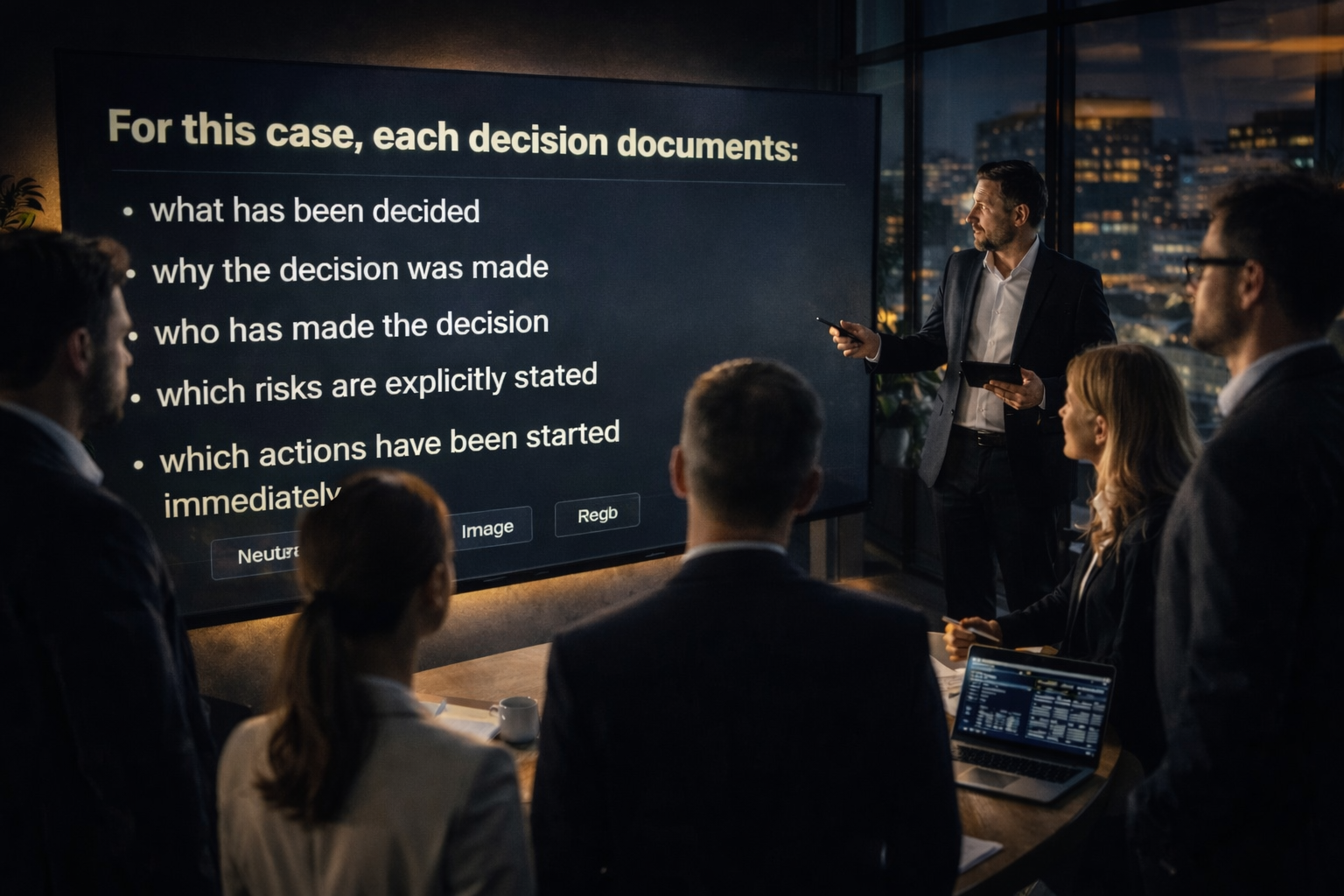
Decision-making made visible
What would normally be scattered across email, chats and memory is now traceable in one controlled dossier line.
central source of truth instead of fragmented communication and disconnected context.
to make a complete dossier controllable, explainable and transferable under pressure.
room for vagueness once management, audit, legal or regulator asks for evidence.
This is not consultancy. This is the structure that makes decision-making defensible.
First test your own organisation. Then compare it with this example. That is how the gap becomes visible — and impossible to ignore.