Governance Reconstruction
Can you rebuild how a decision moved through the organisation from the records you preserved?
A policy shows what should happen. A board minute shows what was approved. Governance reconstruction asks a harder question. Can the organisation show how information, risk, authority and evidence moved before the decision was made?
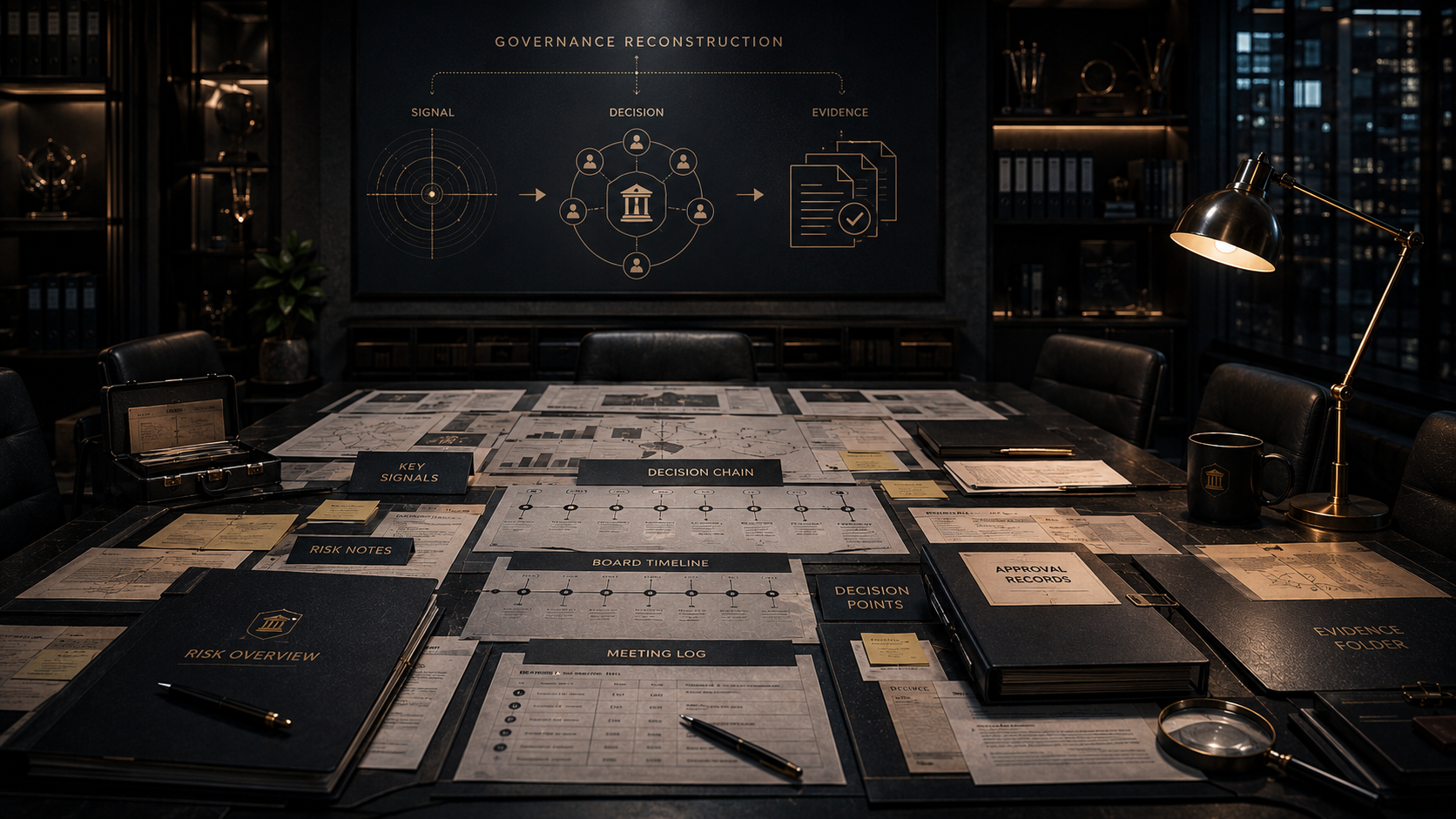
Governance reconstruction is not policy reconstruction
Policy reconstruction shows which rules existed. Governance reconstruction shows how real judgement moved through the organisation. It connects the signal, the risk, the people involved, the authority used, the evidence available and the decision that followed.
A clean governance file can still fail if it cannot show how the decision actually formed.
Many organisations can find the policy. They can find the final approval. They can find the meeting note. What they cannot always show is the movement between those records. That movement is where accountability lives.
Scrutiny does not reconstruct from intention
Auditors, regulators, courts and boards do not reconstruct governance from intent. They reconstruct from what was preserved. If the record cannot show what was known, what was uncertain, who had authority and what evidence supported the decision, the organisation is left explaining after the fact.
That is the danger. The organisation may have acted responsibly, but the record may not prove it. A missing link between knowledge and decision can make careful governance look improvised.
Governance reconstruction reduces that gap. It keeps the decision connected to the circumstances in which it was made, before memory fades and before later explanations begin to shape the file.
Four links that must survive
Signal captured
The record must show what issue, risk, warning, incident or request entered governance attention.
Risk understood
The record must show what was known at the time, what remained uncertain and what consequences were considered.
Authority identified
The record must show who had authority to decide, approve, escalate, defer or accept the risk.
Decision evidenced
The record must connect the final decision to the evidence, reasoning and responsibility that supported it.
Where governance reconstruction breaks
From governance activity to reconstructable evidence
Standard - Structured Dossier Foundation
Standard helps organise facts, evidence, scope, obligations and decisions so the organisation has a clearer foundation before escalation or review.
Pro - Governance and Integrity Layer
Pro adds governance documents around evidence integrity, decision responsibility, access audit boundaries and corrective controls.
Dossier Secure Enterprise is being engineered as forensic governance infrastructure. Its purpose is to connect events, actors, policy evaluation, decisions, evidence objects, outputs, hashes and audit trails into a reconstructable governance chain.
Governance reconstruction explained
What is governance reconstruction?
Governance reconstruction is the ability to rebuild how a decision moved through an organisation from preserved records: what was known, who was involved, what authority existed, which risks were considered, and what evidence supported the final decision.
How is governance reconstruction different from policy reconstruction?
Policy reconstruction shows what rules or procedures existed. Governance reconstruction shows how real decisions moved through people, risk, authority, evidence and approval at the time.
When does an organisation need governance reconstruction?
When an audit, incident, regulator, legal claim, board conflict or public challenge asks the organisation to prove how a decision actually formed.
What fails when governance cannot be reconstructed?
The organisation may still have policies and minutes, but it cannot show the connection between signal, knowledge, risk, authority, decision and evidence. That gap makes the record fragile.
Is Dossier Secure Enterprise fully live for governance reconstruction?
No. Dossier Secure Enterprise is in active development and being engineered as forensic governance infrastructure. Standard and Pro provide the current structured dossier foundation.
Test whether your governance record can be reconstructed
If you cannot show how a decision moved from signal to risk to authority to evidence, the record is not yet defensible.