Audit Reconstruction
Can an auditor rebuild what happened from the evidence you preserved?
An audit does not run on memory. It runs on evidence. When the question becomes serious, the organisation must show the source record, the procedure, the review, the conclusion and the person responsible. If those links are missing, the file may be full and still fail reconstruction.
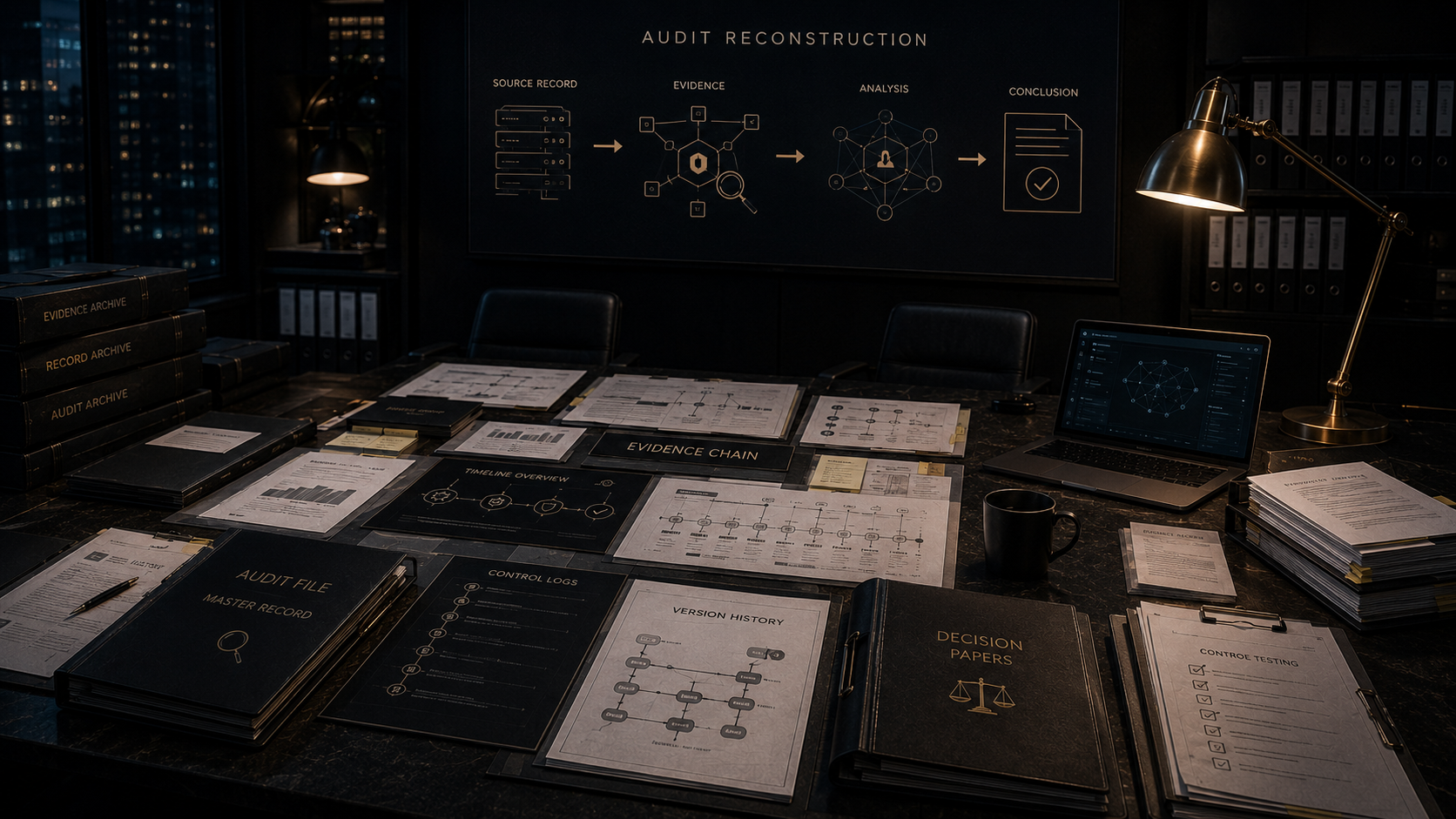
Audit reconstruction is not audit readiness
Audit readiness prepares the organisation before examination. Audit reconstruction asks whether the evidence can later rebuild the real sequence of events. What source record existed. Which procedure was performed. What evidence was obtained. What conclusion followed. Who reviewed it. When that chain is visible, the audit file can speak without explanation.
A final report can look complete while the evidence chain underneath it remains impossible to follow.
That is where many files break. They contain outputs, summaries and approvals. They do not always show how those outputs were reached from original evidence. The auditor then has to ask people to explain the file. That is already a weakness.
Evidence must carry the conclusion
Audit standards focus on evidence because conclusions need a reasonable basis. That does not mean the file must be large. It means the file must be capable of showing the work performed, the evidence obtained and the conclusion reached. Volume is not the same as reconstruction.
The dangerous file is not always empty. Sometimes it is crowded. The issue is that no one can move through it from source to judgment without someone explaining what the records mean.
A reconstructable audit record preserves the path. It shows the original material, the control or procedure applied, the evidence reviewed, the exception considered and the reason a conclusion could be reached.
Four links an audit file must preserve
Source record identified
The file must show what original record, system export, decision paper, log or evidence item was used.
Procedure connected
The file must show what was done with that source record and why the procedure was relevant.
Evidence evaluated
The file must show what evidence supported the conclusion and what uncertainty or exception remained.
Conclusion traceable
The final conclusion must remain connected to the work performed, the evidence obtained and the reviewer responsible.
Where audit reconstruction breaks
From audit material to reconstructable evidence
Standard - Structured Dossier Foundation
Standard helps organise facts, evidence, scope, obligations and decisions so the file has a clearer basis before escalation, review or audit pressure.
Pro - Governance and Integrity Layer
Pro adds governance documents around evidence integrity, decision responsibility, access audit boundaries and corrective controls.
Dossier Secure Enterprise is being engineered as forensic governance infrastructure. Its purpose is to connect events, actors, policy evaluation, decisions, evidence objects, outputs, hashes and audit trails into a reconstructable evidence chain.
Audit reconstruction explained
What is audit reconstruction?
Audit reconstruction is the ability to rebuild what happened from preserved records: which evidence existed, which procedure was followed, who reviewed it, what conclusion was reached and whether the record can be understood without memory or explanation after the fact.
How is audit reconstruction different from audit readiness?
Audit readiness prepares the organisation before an audit. Audit reconstruction tests whether the preserved evidence can later show what actually happened and why a conclusion was reached.
What do auditors need to reconstruct a decision?
They need a record that connects source material, procedure, evidence, review, conclusion and responsibility. A final report alone is not enough if the underlying chain cannot be followed.
What fails during audit reconstruction?
Audit reconstruction fails when evidence is scattered, versions are unclear, conclusions are not tied to source records, responsibility is vague or the organisation depends on people explaining what the file does not show.
Is Dossier Secure Enterprise fully live for audit reconstruction?
No. Dossier Secure Enterprise is in active development and being engineered as forensic governance infrastructure. Standard and Pro provide the current structured dossier foundation.
Test whether your audit record can be reconstructed
If your file cannot connect source evidence to procedure, review and conclusion, the record is not yet defensible.