Incident Reconstruction
Can your organisation reconstruct an incident from evidence instead of memory?
A serious incident is not judged only by what happened. It is judged by what the organisation can prove afterward. The trigger, timeline, evidence, decisions, approvals, response actions and responsibilities must survive as a clear record. Otherwise the incident story is rebuilt under pressure.
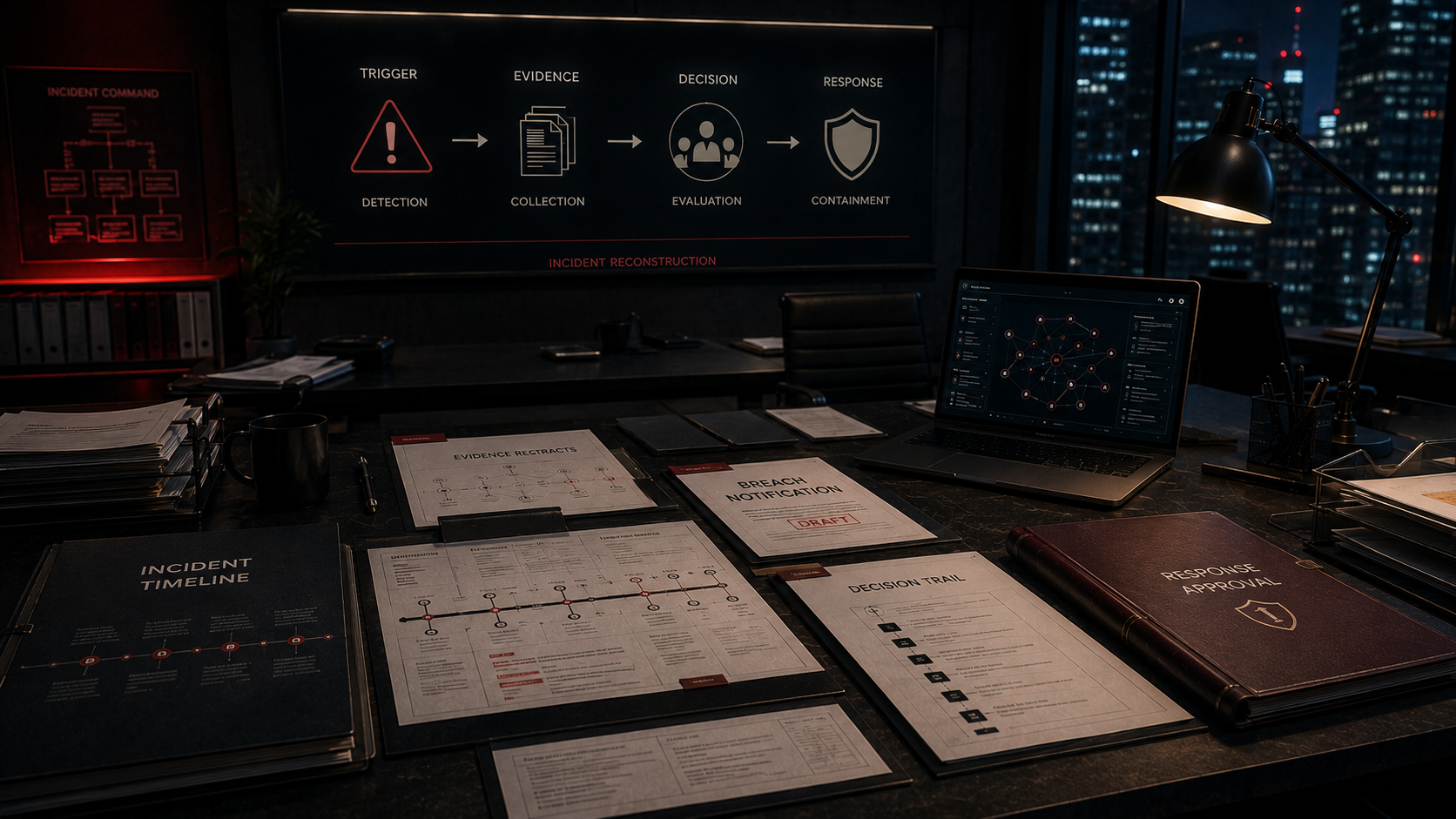
Incident reconstruction is not incident storytelling
Incident reconstruction is the ability to rebuild the event from preserved evidence. It connects the first trigger, the timeline, the records reviewed, the decisions made, the response actions approved and the people responsible. A narrative may explain the incident. A reconstruction must prove it.
An incident file can contain many records and still fail to show the sequence that mattered.
That is where pressure begins. The organisation may know what happened, but knowledge is not enough. The file must preserve the path from evidence to action before memory, blame and later explanation reshape the record.
After an incident, timing becomes evidence
Incident scrutiny often focuses on sequence. What was detected. When it was escalated. Who reviewed it. What impact was understood. Which response was approved. Whether notification, containment or remediation was delayed. If the timeline is weak, the whole position becomes fragile.
The dangerous gap is usually not the final response. It is the missing explanation between trigger and response. Regulators, auditors, boards and insurers will ask how the organisation moved from signal to decision.
A reconstructable incident record protects that movement. It shows what was known at the time, which uncertainty remained and why the response path was reasonable under pressure.
Four links that must survive the incident
Trigger captured
The file must show the first signal, alert, complaint, breach indicator, operational failure or control exception that started the incident path.
Timeline preserved
The record must show what happened when, including escalation, review, impact assessment, containment and response decisions.
Evidence connected
The organisation must preserve logs, documents, communications, approvals and source material that support the incident account.
Response evidenced
The final response must remain connected to responsibility, reasoning, evidence, review and approval at the time action was taken.
Where incident reconstruction breaks
From incident pressure to reconstructable evidence
Standard - Structured Dossier Foundation
Standard helps organise facts, evidence, scope, obligations and decisions so the incident record has a clearer foundation before escalation or review.
Pro - Governance and Integrity Layer
Pro adds governance documents around evidence integrity, decision responsibility, access audit boundaries and corrective controls.
Dossier Secure Enterprise is being engineered as forensic governance infrastructure. Its purpose is to connect events, actors, policy evaluation, decisions, evidence objects, outputs, hashes and audit trails into a reconstructable incident evidence chain.
Incident reconstruction explained
What is incident reconstruction?
Incident reconstruction is the ability to rebuild what happened during a serious event from preserved records: the trigger, timeline, evidence, decisions, approvals, response actions and responsibilities.
Why is incident reconstruction important?
It matters because organisations are often judged after the event, when regulators, auditors, boards, insurers or courts ask what was known, when it was known and why specific actions were taken.
What evidence is needed to reconstruct an incident?
An incident record needs source logs, timeline evidence, internal decisions, response approvals, communications, escalation records, impact analysis and the reasoning behind key actions.
What breaks incident reconstruction?
Incident reconstruction breaks when logs are scattered, timestamps are unclear, decisions are not recorded, evidence is collected late or the organisation depends on memory to explain what happened.
Is Dossier Secure Enterprise fully live for incident reconstruction?
No. Dossier Secure Enterprise is in active development and being engineered as forensic governance infrastructure. Standard and Pro provide the current structured dossier foundation.
Test whether your incident record can be reconstructed
If your organisation cannot connect trigger, timeline, evidence, responsibility and response, the incident record is not yet defensible.